

Table of Contents
- Why Your Body Feels Unsteady After Surgery
- Orthostatic Hypotension After Surgery: What's Actually Happening
- Medications and Side Effects That Cause Dizziness
- How to Stand Up Safely: A Step-by-Step Maneuver
- Post-Surgery Hydration Tips to Keep Blood Pressure Steady
- Setting Up Your Home to Prevent Falls
- When to Seek Emergency Care for Post-Op Dizziness
- What Recovery Timeline to Expect for Lightheadedness
- Frequently Asked Questions
Last Updated: September 27, 2026
Why Your Body Feels Unsteady After Surgery
If you feel lightheaded standing after surgery, you are not imagining it, and you are not being dramatic. Your body went through a major event, and it is still recalibrating.
At The Zipper, a community built by and for heart surgery survivors, this is a common question. The short answer: your blood pressure, blood volume, and nervous system are all out of sync right now.
Orthostatic hypotension after surgery is the medical name for the drop in blood pressure that happens when you move from lying down to sitting or standing. It causes dizziness, lightheadedness, and that floaty feeling in your head.
Why does it happen? Three big reasons:
- Anesthesia and sedation slow your circulation and blur your body's signals
- Pain medication relaxes your blood vessels
- Dehydration lowers your blood volume
The good news is that this is usually temporary. The better news is that you can do something about it today.
Orthostatic Hypotension After Surgery: What's Actually Happening
Orthostatic hypotension is defined as a drop of at least 20 mmHg in systolic blood pressure or 10 mmHg in diastolic blood pressure within three minutes of standing. That three-minute window is not arbitrary, it is the period during which a healthy circulatory system should have fully compensated. When it hasn't, you feel it.
Here is the sequence most patients experience:
- You sit up or stand
- Roughly 500 to 1,000 milliliters of blood pools in your legs and abdomen
- Venous return to the heart drops, so stroke volume drops
- Your brain gets less blood for a moment
- You feel dizzy, wobbly, or foggy
This is not a sign that something went wrong. It is a sign that your circulatory system is still waking up.
The Baroreceptor Reflex, and Why It's Slow After Surgery
Your body has a built-in blood pressure autopilot called the baroreceptor reflex. Stretch-sensitive nerve endings in your carotid arteries and aortic arch constantly sample your blood pressure and send that signal to your brainstem. When pressure falls, the brainstem fires back two commands: tighten the blood vessels (vasoconstriction) and speed up the heart.
After surgery, that loop is sluggish for several reasons:
- Anesthetic agents blunt the sensitivity of those stretch receptors
- Opioid painkillers suppress the sympathetic nervous system that carries the signal
- Reduced blood volume (from fasting, blood loss, or diuretics) means there is less fluid to push against the vessel walls in the first place
- Bed rest itself deconditions the reflex, the longer you lie flat, the slower it responds when you finally stand
That lag is what makes you feel lightheaded standing after surgery. Your heart may also be beating less forcefully than usual, which adds to the drop.
Blood Pressure Fluctuations and Your Circulatory System
Your circulatory system uses tiny muscles in your blood vessel walls to keep pressure steady. This is called vasoconstriction. When you stand, those muscles should tighten within seconds.
A few things make that harder after surgery:
- Vessel stiffness or medication effects can slow the squeeze
- Low circulating volume means there is less to squeeze
- Pain and stress hormones can cause erratic swings rather than a smooth correction
This is why your blood pressure may read normal while you are lying down and then drop sharply the moment you stand. A single cuff reading taken while seated will not catch it. If your care team wants to confirm the diagnosis, they may check your blood pressure lying down, then again after one minute and three minutes of standing, a simple bedside test, not a special procedure.
Anesthesia, Sedation, and Lingering Effects
Anesthesia does not leave your body the moment you wake up. Sedation can linger for days, and its effects on blood pressure can last even longer, particularly after longer procedures or in older adults.
Common lingering effects include:
- Dizziness when changing position
- Fatigue that hits suddenly
- Nausea, especially in the morning
- Trouble with balance and coordination
- Mild short-term memory fog
These are normal. They fade as your body clears the medication and rebuilds its own regulation. The key point is that the reflex has to be retrained, not just waited out, which is why the standing technique in the next section matters as much as time does.
Medications and Side Effects That Cause Dizziness
Pain medication is often the hidden culprit behind post-op dizziness. Narcotic painkillers relax blood vessels and slow your reflexes, which makes blood pressure drops worse.
Other medications that can add to the problem:
- Blood pressure drugs that are now too strong for your lighter body
- Diuretics that pull fluid out of your system
- Anti-nausea drugs that cause drowsiness
A common mistake is assuming you must tough it out. You do not. Ask your care team if any of your medications could be adjusted.
How to Stand Up Safely: A Step-by-Step Maneuver
Standing up safely is a skill you can practice. The goal is to give your blood pressure time to catch up with your body.
Follow these steps every time you get up:
- Lie still for 30 seconds. Take three slow breaths.
- Roll to your side. Bend your knees toward your chest.
- Push up to sitting. Use your arms, not your core.
- Sit on the edge of the bed. Let your legs dangle for 60 seconds.
- Pump your ankles. Flex and point your feet ten times.
- Stand with support. Hold a walker, chair, or steady arm.
- Wait 30 seconds. Do not walk until your head feels clear.
If you feel dizzy at any step, sit or lie back down. There is no prize for pushing through.
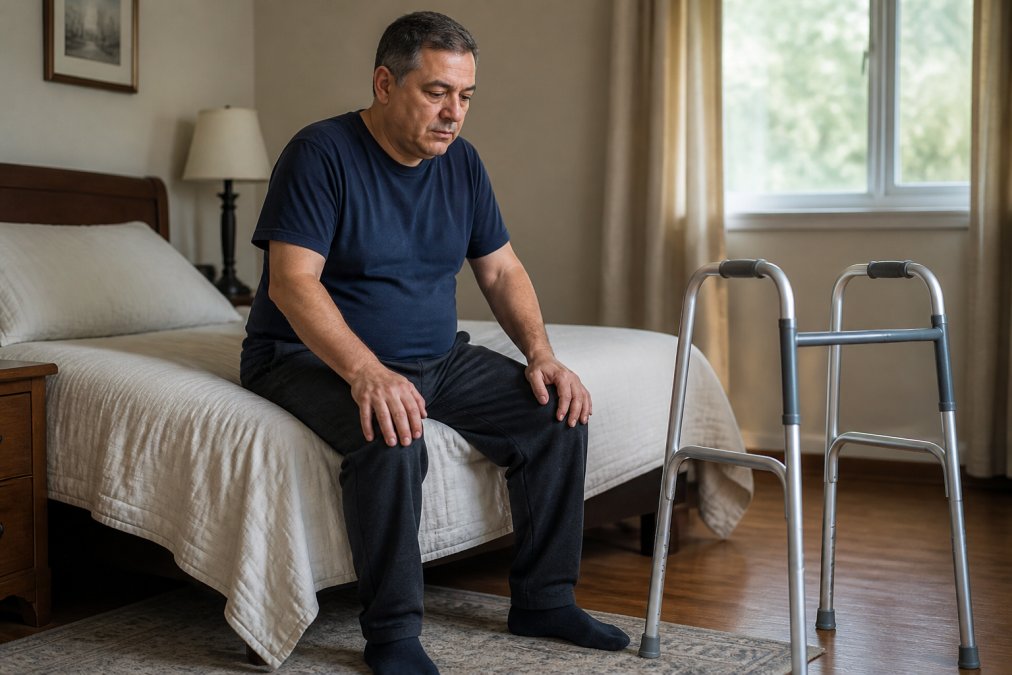
The Dangle Technique Before You Rise
The dangle technique means sitting on the edge of the bed with your legs hanging down before you stand. It sounds too simple to matter. It matters.
Dangling lets gravity pull blood into your legs while you are still supported. Your body gets a head start on vasoconstriction. Most people find that 60 seconds of dangling removes most of the head rush.
Post-Surgery Hydration Tips to Keep Blood Pressure Steady
Fluid intake is one of the few things you fully control right now. Low blood volume makes every blood pressure drop worse.
Try these post-surgery hydration tips:
- Keep a water bottle within arm's reach at all times
- Drink a full glass before getting out of bed in the morning
- Aim for pale yellow urine, not clear and not dark
- Add electrolytes if your care team approves
- Limit caffeine, which can dehydrate you
Electrolyte balance matters as much as water. Sodium and potassium help your body hold onto fluid instead of flushing it out.
A 17-ounce insulated bottle like this one from The Zipper keeps water cold for hours, which makes it easier to sip steadily instead of gulping once a day. The leak-proof cap means you can keep it on the couch or bedside table without worry.

Setting Up Your Home to Prevent Falls
Fall prevention is the part most recovery guides skip. Dizziness plus a hard floor is a bad combination.
Start with these changes:
- Clear a straight path between your bed, bathroom, and kitchen
- Add nightlights to hallways and bathrooms
- Remove loose rugs and trailing cords
- Install grab bars in the shower and beside the toilet
- Keep a charged phone in your pocket, not across the room
- Wear shoes with real soles, not loose slippers
Small changes add up. A clear path and good lighting do more for your safety than any single device.
When to Seek Emergency Care for Post-Op Dizziness
Most lightheadedness after surgery is expected. Some of it is not. Knowing the difference matters.
Call emergency services right away if you have:
- Fainting or a full loss of consciousness
- Chest pain or pressure
- Shortness of breath that does not ease when you sit
- A racing or irregular heartbeat that lasts
- Confusion, slurred speech, or one-sided weakness
- A fall with a head injury, especially on blood thinners
Call your surgeon's office the same day if you have:
- Dizziness that is getting worse instead of better
- Repeated near-fainting spells
- Vomiting that stops you from keeping fluids down
- A fever
Trust your gut. If something feels wrong, it is worth a phone call.
What Recovery Timeline to Expect for Lightheadedness
Most patients notice their dizziness fading within one to two weeks. Full resolution often takes longer, especially after open-heart surgery. But "one to two weeks" is not specific enough to help you decide whether what you are feeling today is normal. Here is a more useful way to think about it.
The First 48 Hours: Highest Risk Window
The first 48 hours after surgery, and especially the first time you stand after anesthesia, carry the highest risk of a significant blood pressure drop. This is when the baroreceptor reflex is at its slowest, when residual sedation is strongest, and when you are most likely to be dehydrated from pre-op fasting. Do not stand alone during this window if you can avoid it. Use a call button, ask for a hand, and treat every first stand of the day as a two-person job.
Days 3 to 7: Dizziness on Position Change Is Expected
By day three, most patients can stand with assistance but still feel a head rush when moving from lying to standing. This is the phase where the dangle technique and ankle pumps do the most work. Dizziness that is triggered only by position change and resolves within 30 seconds of sitting back down is the expected pattern.
Weeks 2 to 4: Morning Dizziness Should Be Improving
If you are still getting dizzy every morning at the two-week mark but the spells are shorter and less intense, you are on track. If they are the same or worse, that is worth a call to your surgeon's office, not an emergency, but not something to wait out either.
Weeks 4 to 8: Occasional Spells After Standing Fast
By this point, most patients only feel lightheaded when they stand up too quickly or when they are behind on fluids. Spells that appear only in those situations are usually benign. Spells that appear at rest, or that come with palpitations, are not.
Month 2 and Beyond: Rare and Usually Tied to Dehydration
If dizziness is still a regular part of your day two months after surgery, the cause is usually something identifiable, a medication that needs adjusting, lingering dehydration, deconditioning, or an underlying rhythm issue. This is the point to push for a real workup rather than accepting it as "just recovery."
| Phase | Typical Experience | What Helps Most | When to Call |
|---|---|---|---|
| First 48 hours | Dizziness on any first stand | Assistance, dangle technique, IV or oral fluids | Any faint, fall, or chest pain |
| Days 3-7 | Head rush on position change | Slower transitions, ankle pumps, hydration | Dizziness that does not ease when seated |
| Weeks 2-4 | Morning dizziness, improving | Daily walking, medication review | No improvement, or getting worse |
| Weeks 4-8 | Occasional spells after standing fast | Pacing, steady fluids | Spells at rest or with palpitations |
| Month 2+ | Rare, tied to dehydration | Hydration, activity, medication check | Persistent or worsening symptoms |
The Red-Flag Line: When "Normal" Ends
The clearest dividing line is this: dizziness that is provoked by standing and relieved by sitting is the expected pattern. Dizziness that happens at rest, that comes with chest pain, shortness of breath, a racing or irregular heartbeat, confusion, slurred speech, or one-sided weakness is not, call emergency services. Dizziness that is steadily worsening instead of improving, or that comes with repeated near-fainting spells, warrants a same-day call to your surgeon's office.
Your timeline depends on your surgery, your medications, and your overall health. Some people bounce back in days. Others take months. Both can be normal, but "getting worse" never is.
Anxiety makes dizziness feel worse, and that is not weakness. Talking with people who have been through it helps more than most people expect.
Frequently Asked Questions
Is it normal to feel dizzy after surgery?
Yes, feeling dizzy or lightheaded after surgery is common, especially in the first days and weeks. Anesthesia, pain medication, dehydration, and changes in blood pressure can all contribute. Your body is still adjusting, and standing up too quickly can make it worse. Mention it to your care team so they can check your vital signs and rule out anything more serious.
What causes orthostatic hypotension after surgery?
Orthostatic hypotension after surgery happens when your blood pressure drops suddenly as you move from lying or sitting to standing. Surgery, anesthesia, dehydration, blood loss, and some medications can interfere with the reflexes that normally keep blood pressure steady. Your circulatory system needs time to readjust, so the drop is more likely during early recovery.
How long does post-operative lightheadedness last?
For many people, lightheadedness improves within a few days to a couple of weeks as hydration, medication, and circulation stabilize. If you had open-heart surgery or a longer operation, it may take a bit longer. If it persists beyond a few weeks or gets worse, contact your doctor to rule out medication issues or other causes.
When should I call my doctor about dizziness after surgery?
Call your doctor if dizziness keeps you from walking, comes with chest pain, shortness of breath, a racing heartbeat, confusion, or fainting. Also reach out if it starts suddenly or gets worse over time. These could signal a blood pressure problem, dehydration, or a medication side effect that needs adjusting.


