

Table of Contents
- Why Fear of Exercising After Heart Surgery Is Normal
- How Cardiac Rehab Exercise Guidelines Ease Anxiety
- Step 1: Get Medical Clearance Before You Start
- Step 2: Safe Home Exercises for Heart Surgery Patients
- Step 3: Heart Rate Monitoring After Surgery
- Step 4: Recognizing Signs of Overexertion After Heart Surgery
- Step 5: Managing Exercise Anxiety and Building Confidence
- Conclusion: Your Path to Moving Forward
- Frequently Asked Questions
Last Updated: September 5, 2026
Why Fear of Exercising After Heart Surgery Is Normal
The fear of exercising after heart surgery is one of the most common and understandable responses to a major medical event. Your chest was just opened, your sternum is healing, and every physical sensation can feel like a warning sign. This anxiety is not a personal failing; it is a natural protective response from a body that has been through significant trauma.
At The Zipper, a community founded by heart surgery survivor Steve Rucinski, we hear this fear echoed daily from members navigating post-surgical recovery. The key insight is that fear and recovery can coexist. You do not need to eliminate anxiety before you move; you need to learn how to move safely alongside it.
Cardiac rehabilitation exists precisely because structured physical activity after surgery rebuilds cardiovascular fitness while reducing the risk of complications. The American Heart Association notes that participation in cardiac rehab can significantly improve recovery outcomes and quality of life (heart.org). The goal is not to push through fear, but to build a framework where exercise becomes predictable, monitored, and gradual.
How Cardiac Rehab Exercise Guidelines Ease Anxiety
Cardiac rehab exercise guidelines are designed to replace guesswork with structure, which directly addresses the uncertainty that fuels fear of exercising after heart surgery. When every movement feels risky, having clear parameters for intensity, duration, and progression restores a sense of control.
Most programs follow a phased approach that begins with supervised exercise in a clinical setting where your heart rhythm and blood pressure are monitored continuously. This phase typically includes light aerobic exercise such as walking on a treadmill or using a stationary bike, starting at low metabolic equivalent levels. As you demonstrate tolerance, the prescription advances to include resistance training with light weights, always respecting sternal precautions.
The structure matters as much as the activity itself. Each session includes a proper warm-up and cool-down, which helps your autonomic nervous system transition smoothly between rest and exertion. Knowing that your perceived exertion is tracked against objective measures like heart rate removes the guesswork, helping you trust both the data and your body's signals again.
Step 1: Get Medical Clearance Before You Start
Before attempting any exercise after heart surgery, you must obtain explicit clearance from your cardiologist or cardiac surgeon. This is not a formality; it is the foundation of safe physical activity. Your medical team needs to assess your surgical healing, ejection fraction, and any residual issues like arrhythmias or exercise intolerance before approving an exercise plan.
During your follow-up appointment, ask specific questions about your recovery phases. When can you lift more than ten pounds? When are sternal precautions no longer a concern? What heart rate zone should you target? Write down the answers. Having concrete numbers from your physician transforms vague worry into a clear, actionable exercise prescription.
Step 2: Safe Home Exercises for Heart Surgery Patients
Safe home exercises for heart surgery patients focus on low-impact activity that builds endurance without straining the chest. Walking is the cornerstone of early home recovery, and it is remarkably effective for improving cardiac output and vascular health over time. But the real challenge isn't the first week of walking; it's the transition from the structured, monitored environment of cardiac rehab to the unstructured reality of your living room. This section provides a concrete, week-by-week bridge to help you make that leap confidently.
Phase 1: The 'Replication' Week (Weeks 1-2 Post-Rehab)
Your first goal is not to do more, but to replicate exactly what you did in your final week of cardiac rehab. If your last rehab session was 20 minutes on the treadmill at 2.5 miles per hour, do precisely that at home, using the same warm-up and cool-down routine. The only variable that changes is the location. Log your heart rate before, during, and after each session. If your heart rate stays within the same range you saw in rehab, you have objective evidence that your home environment is not a physiological stressor.
Phase 2: The 'Extension' Week (Weeks 3-4 Post-Rehab)
Once you have successfully replicated your rehab routine for a week, you can begin to extend it. Add just 2 to 3 minutes to your main cardio session every other day. Do not increase both duration and intensity in the same week. If you want to add a new exercise, such as a stationary bike, introduce it on a separate day from your main walk. This is also the time to start a simple strength routine using resistance bands or light hand weights (1-2 pounds), focusing on exercises that do not strain your chest: seated rows, bicep curls, and leg presses. Exhale on the effort and never hold your breath, as this can spike your blood pressure.
Phase 3: The 'Integration' Month (Weeks 5-8 Post-Rehab)
By this point, you should have a solid routine. The next step is to integrate exercise into your daily life in a way that feels sustainable, not like a medical obligation. This is where you transition from 'doing rehab at home' to 'having an active lifestyle.' Try these strategies:
- The 'Ten-Minute Rule': Instead of one 30-minute walk, break it into three 10-minute walks after meals. This is just as effective for cardiovascular health and is easier to fit into a busy day.
- The 'Sweep and Stretch' Protocol: Do 5 minutes of light housework (sweeping, dusting) followed by 5 minutes of gentle stretching. This counts as movement and helps you associate everyday activity with safety.
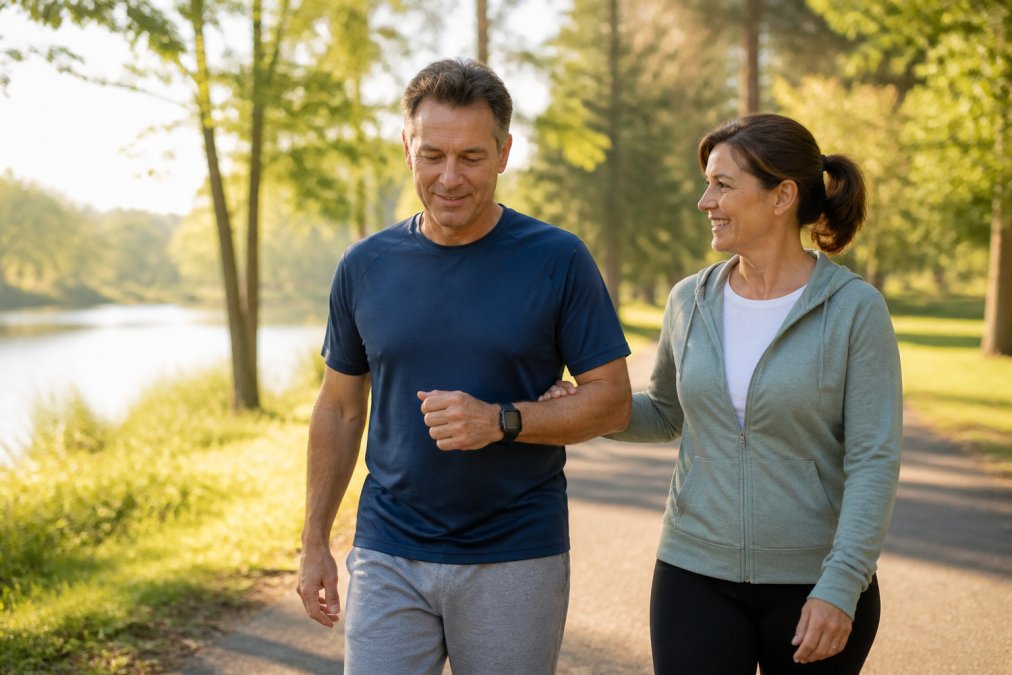
- The 'Social Walk': Invite a friend or family member to walk with you. Having a conversation partner naturally regulates your pace to a safe level and provides a welcome distraction from body-focused anxiety.
Building Your Home 'Rehab Zone'
To make this transition easier, set up a dedicated space in your home that mimics the safety of rehab. This is not about expensive equipment; it's about creating a predictable environment. Designate a corner of a room where you have your mat, your water bottle, your heart rate monitor, and a written copy of your exercise plan. Having a physical space associated with safe exercise can trigger a conditioned relaxation response, reducing anticipatory anxiety before you even begin.
A common mistake is trying to progress too quickly because you feel good one day. Recovery is not linear. Some days your energy will surprise you; other days you will feel profoundly fatigued. A sedentary lifestyle followed by sudden activity is far riskier than consistent, gentle movement. The transition from rehab to home is a bridge you build, one small, predictable step at a time.
Step 3: Heart Rate Monitoring After Surgery
Heart rate monitoring after surgery is your most reliable tool for ensuring you exercise within a safe intensity zone. Your cardiac rehab team or cardiologist will typically provide a target heart rate range, often calculated as a percentage of your maximum predicted heart rate.
A wearable device that tracks your pulse continuously is invaluable here. Many patients find that a smartwatch with heart rate alerts provides peace of mind, allowing them to focus on the activity rather than constantly checking their pulse manually. If you do not have a wearable, you can take your pulse at your wrist for fifteen seconds and multiply by four.
The rate of perceived exertion scale, which rates effort from 6 to 20, is another effective method. During the early weeks of recovery, aim for a level where you can hold a conversation comfortably (the CDC). If you are too breathless to speak in full sentences, you are working too hard.
Step 4: Recognizing Signs of Overexertion After Heart Surgery
Knowing the signs of overexertion after heart surgery is just as important as knowing how to exercise. Your body will give you clear warnings when you have crossed the line from beneficial activity into dangerous territory, and you must honor those signals immediately.
Stop exercising and rest if you experience any of the following warning signs:
- Chest pain, pressure, or tightness that feels different from your incision discomfort
- Shortness of breath that does not resolve quickly with rest
- Dizziness, lightheadedness, or feeling faint
- An irregular or racing heartbeat
- Excessive fatigue that lasts for hours after exercise
- Swelling in your legs or ankles
Angina, which is chest pain caused by reduced blood flow to the heart, is a critical signal that must never be ignored. If your symptoms persist after a few minutes of rest, or if they worsen, call 911 immediately. It is always better to seek emergency care for a false alarm than to dismiss a genuine cardiac event.
Keep a simple log of your exercise sessions, noting the duration, your perceived exertion, and any symptoms you experienced. This record becomes a valuable tool for your cardiac rehab team to adjust your exercise prescription safely.
Step 5: Managing Exercise Anxiety and Building Confidence
Managing exercise anxiety after heart surgery requires more than just being told to 'relax' or 'take it easy.' The fear is often rooted in a specific cognitive loop: your heart beats faster during exertion, your brain interprets that sensation as a sign of impending danger, and that interpretation triggers a surge of adrenaline that makes your heart beat even faster. This is a classic anxiety feedback loop, and it can be broken with targeted techniques drawn from cognitive behavioral therapy (CBT).
Cognitive Restructuring: Label the Sensation, Not the Catastrophe
The first step is to practice cognitive restructuring. When you feel your heart rate rise during a walk, pause and name what is actually happening. Instead of thinking, "My heart is racing, something is wrong," train yourself to think, "My heart rate is elevated because I am walking at a brisk pace. This is a normal, expected physiological response to exertion." This simple act of labeling the sensation accurately, as a data point, not a threat, reduces its emotional charge. Keep a small card or a note on your phone with a list of these accurate labels: "Heart rate of 110 is a normal response to exercise," "Shortness of breath that resolves when I slow down is normal," "Mild fatigue after a workout is a sign of progress, not damage."
Interoceptive Exposure: The 'Bother It, Don't Battle It' Technique
A more advanced CBT technique is interoceptive exposure, which involves deliberately and safely triggering the physical sensations you fear in a controlled setting. This is not about pushing through pain; it is about teaching your brain that the sensation itself is not dangerous. For example, if the feeling of being out of breath terrifies you, practice a simple breathing exercise where you take a few quick, shallow breaths for 30 seconds while seated, just enough to feel slightly breathless. Then, let your breathing return to normal. Do this a few times a day. Over time, your brain learns that breathlessness is uncomfortable but not catastrophic, and the fear response diminishes. Always do this with your doctor's knowledge and only after you are cleared for light activity.
Behavioral Activation: The 'One More Lamp Post' Rule
Behavioral activation is about using small, concrete goals to build evidence against your fears. Instead of a vague goal like "walk more," set a specific, achievable target that forces you to gently challenge your comfort zone. For example, if you can walk to the end of your driveway without anxiety, your goal for the next session is to walk to the next lamp post and back. The following session, you walk to the second lamp post. This graded exposure creates a predictable ladder of success. Each time you achieve a goal, you are building a log of evidence that your body is capable and that your fear was wrong. This evidence is the most powerful antidote to anxiety.
The 'Worry Time' Technique for Post-Exercise Anxiety
Many patients find that anxiety spikes not during exercise but in the hours afterward, as they scan their bodies for any sign of trouble. To manage this, use a technique called 'worry time.' Schedule a dedicated 15-minute block each day, at the same time, to think about your recovery worries. When a catastrophic thought arises during the day, write it down on a notepad and tell yourself, "I will address this during my worry time." When the scheduled time arrives, review your list. You will often find that most of the worries you wrote down earlier in the day no longer feel urgent or realistic. This technique contains the anxiety, preventing it from spilling into your entire day and discouraging you from your next workout.
Connecting with others who have navigated this same fear can be transformative. At The Zipper, our community includes members who are months or years past their surgery and who remember exactly how terrifying those first walks felt. Their reassurance, offered from lived experience, often carries more weight than clinical advice alone. You can engage as much or as little as you prefer, using the resources and tools without participating in discussions if that feels right for you.
Conclusion: Your Path to Moving Forward
Rebuilding your relationship with physical activity after heart surgery is a gradual process that requires patience, structure, and self-compassion. The fear you feel is a testament to what your body has survived, not a weakness. By following cardiac rehab exercise guidelines, monitoring your heart rate, respecting the signs of overexertion, and addressing your exercise anxiety directly, you can rebuild both your cardiovascular fitness and your confidence.
The Zipper was founded by Steve Rucinski, a heart surgery survivor who understands the emotional weight of this journey. Our community provides peer support, evidence-based guidance, and practical tools to help you navigate every stage of recovery, from those first tentative steps to long-term independence. You do not have to face this fear alone.
Frequently Asked Questions
How do I know if I am overexerting myself after heart surgery?
Watch for specific signs of overexertion after heart surgery: chest pain, unusual shortness of breath, dizziness, excessive sweating, or an irregular heartbeat. Stop exercising immediately if you feel any of these. Your target heart rate zone, determined by your care team, is your best guide. Slow down if you cannot talk comfortably during activity. Call your surgeon's office if symptoms persist after a few minutes of rest.
What is the safest way to start exercising again after open heart surgery?
Always get written clearance from your surgeon first, usually at your 6-week follow-up. Then start with short walking sessions of 5-10 minutes at a gentle pace, several times per day. Follow your cardiac rehab exercise guidelines, which typically recommend gradual increases of 1-2 minutes per week. Sternal precautions, like avoiding pushing or pulling movements, remain important for up to 12 weeks. A structured program removes guesswork.
How can I build confidence in my heart's strength after surgery?
Confidence returns through gradual, repeated success. Start with supervised exercise sessions in cardiac rehab where monitors track your progress. Keep a simple log of your walks, noting distance and how you felt. Wear a heart rate monitor to see concrete proof your heart is responding normally to activity. Remind yourself that feeling short of breath or tired is a normal part of reconditioning, not a sign of damage.
What role does cardiac rehabilitation play in reducing exercise anxiety?
Cardiac rehab provides a supervised setting where medical staff monitor your heart rate and rhythm during exercise. This structure directly reduces fear because you have professionals watching for signs of overexertion. Rehab also introduces you to other patients with similar fears, which normalizes your anxiety. Most programs last 12-36 sessions, giving you time to build cardiovascular fitness and confidence before exercising independently.


